
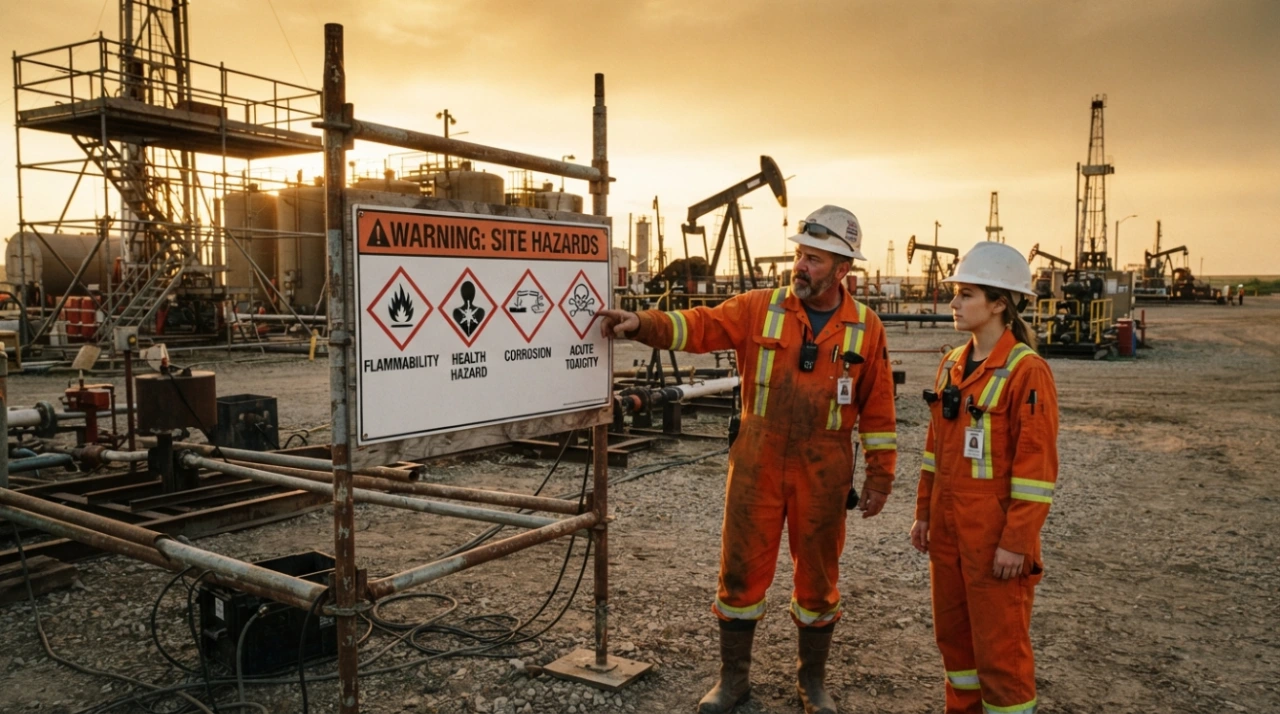
A worker steps off a truck at a remote lease site. It is minus 22, the light is flat, and they have never been on this property before. Within about ten seconds, they need to know what is stored here, what could hurt them, and what gear they need before walking any further. That is the job your signage has to do.
WHMIS signs for oilfield operations are not paperwork. They are the fastest way to tell someone what a container holds and how to handle it safely. On industrial facilities and remote lease sites across Northern BC, they often speak before any supervisor does.
This guide covers what WHMIS signage is, where it belongs on your site, what materials survive our winters, and how to plan it without redoing the whole thing next season.
What WHMIS Signage Actually Does on a Worksite
WHMIS stands for the Workplace Hazardous Materials Information System. It is Canada’s national hazard communication system, and it now lines up with the global GHS standard.
The system runs on three parts working together:
- Supplier labels that arrive on the product from the manufacturer
- Workplace labels you create when a product moves into a different container
- Safety Data Sheets that workers can access on site
Signs and placards are the piece people underestimate. For hazardous products in piping systems, process vessels, tanks, or similar systems, workplace rules may allow identification methods other than a conventional container label. The appropriate labels, placards, tags, colour coding, or other markings should be determined under the applicable workplace requirements and safety program.
WHMIS uses standardised pictograms such as the flame, gas cylinder, corrosion, skull and crossbones, health hazard, exclamation mark, flame over circle, exploding bomb, and biohazard symbol where the applicable hazard classification requires them. Most crews recognise these on sight.
Why “generic” often falls short
Off-the-shelf signs handle the obvious stuff. They cannot tell a contractor that Tank 3 was repurposed last spring, or that the north gate is now a restricted route. Every operation has its own traffic patterns, restricted zones, and emergency procedures. Custom hazard communication signs let you post what is actually true about your site instead of something close enough. We cover this in more depth in our breakdown of signage built around a site’s real safety plan.
Where WHMIS Signs Belong on Oil and Gas Sites
Placement decides whether a sign gets read or ignored. A few areas do the heavy lifting. Site entrances and gates: People need hazard information before they are inside the fence, not after. Entrance signage sets expectations for drivers, subcontractors, and visitors arriving for the first time. Chemical storage areas: WHMIS signage for chemical storage areas should be readable from outside the storage zone. If someone has to walk in to learn what is in there, the sign is already too late.
Tanks, vessels, and bulk containers: Large containers need placards sized to match viewing distance. A sign readable at three metres is useless on a tank people approach from twenty. Piping and process lines: Pipeline systems carrying hazardous product need consistent marking. Colour, content, and flow direction should stay the same across the whole facility.
Equipment and process zones: Equipment identification tags reduce guesswork during maintenance, lockout, and shift handovers. Muster points and emergency routes: These need to hold up in poor visibility, not just on a clear July afternoon.
WHMIS signs for oil and gas facilities work best when they follow how people actually move through the property. Walk your site the way a first-time visitor would. The gaps usually announce themselves.
Custom WHMIS Signs for Industrial Sites: Building Signage Around Your Operation
This is where most compliance gaps get closed. Custom WHMIS signs for industrial sites let you match signage to your real layout, your real products, and your real procedures. A processing facility with six storage zones does not have the same needs as a single-wellsite lease.
Here is what custom actually buys you:
Accurate product identification. Your workplace labels and area signage name the specific products stored in each zone, not a general warning that could apply anywhere.
Site-specific instructions. Required PPE, contact numbers, check-in procedures, and access rules printed directly on the sign. No separate binder required.
Consistent sizing. Larger formats for roadside and tank applications. Smaller lamacoids and reflective decals for equipment identification and cabinet marking.
Bilingual layouts where needed. Useful on projects with mixed crews or federal requirements. Matched material to location. An indoor control room sign and an outdoor tank placard should not be made from the same thing. Room to update. Sites change. Signage that can be reprinted and swapped without redesigning the whole system saves money over a few seasons.
At SignWorks, custom hazard communication signs are produced in-house, with design, fabrication, and installation under one roof. That matters when a compliance deadline is close, and you cannot wait three weeks for a reprint from out of province.
Choosing Durable WHMIS Signs for Outdoor Workplaces
Northern BC punishes cheap signage. Snow load, freeze-thaw cycles, road spray, mud, wind, UV exposure, and short winter daylight all work against it.
Durable WHMIS signs for outdoor workplaces usually come down to a few material choices:
| Material | Best for | Why it holds up |
| Aluminum composite | Tank placards, entrance signs, fence-mounted panels | Will not rust, handles wind, stays flat in temperature swings |
| Reflective vinyl on aluminum | Low-light zones, muster points, roadside hazard marking | Readable under headlights and work lights |
| Lamacoids (engraved plastic) | Equipment identification, valve and panel tags | Text is engraved, so it cannot wear off |
| Heavy-gauge vinyl decals | Drums, cabinets, secondary containers | Fast to apply and replace when product changes |
| Polycarbonate | High-abuse interior areas | Resists impact and chemical splash |
Two failure points cause most reprints. The first is UV fade: cheap inks lose contrast in about a season, and a faded pictogram stops working. The second is adhesive failure, when a decal rated for mild climates lifts at the corners after the first hard freeze.
Mounting matters as much as the panel. Fasteners should suit the surface and the wind exposure. We break down the practical side of this in our guide to what proper installation does for long-term sign performance.
Temporary versus permanent placement
Some hazards are permanent. Others last one turnaround. Matching the format to the timeline keeps costs sensible and prevents old instructions from staying up after conditions change a comparison we walk through in choosing between short-term and fixed safety signage.
Planning WHMIS Signage for Remote Work Sites
Remote sites carry a problem that facilities do not: nobody is walking past every day to notice a damaged sign. WHMIS signage for remote work sites should be planned with that in mind. Order spares up front. Replacing one sign on a site two hours out costs far more than the sign. Keep extras in the truck. Standardise across locations. Same layout, same sizes, same materials at every lease. Crews then read signs by pattern, not by effort.
Photograph and log placements. A simple record of what is posted where makes audits and replacements straightforward. Build in a seasonal check. A quick walkthrough before winter catches fading, lifting edges, and loose fasteners while they are still cheap to fix. Account for snow height. A sign mounted low in August can be buried by February. Mounting height should reflect winter conditions, not summer ones.
WHMIS signs for Northern BC worksites also need to work in poor visibility. Reflective faces and high-contrast layouts do more for readability here than clever design does. Contractors running active job sites face a related set of problems, which we cover in our look at common jobsite signage errors that create confusion.
What This Means for Your Bottom Line
Good hazard signage is not only a compliance item. Clear WHMIS signs for oilfield and industrial facilities reduce time lost to questions. Contractors find the right entrance. Drivers stop in the right place. New workers know what PPE to wear before they need to ask.
There is a documented link between clear hazard marking and fewer incidents, which we explore in how well-planned safety signs lower workplace accident rates. The same reasoning applies to active projects, covered in why hazard signage is not optional on a jobsite.
There is also an audit angle. When an inspector arrives, consistent and legible signage tells them your safety program is managed, not improvised. That impression shapes the rest of the visit.
Getting Your Site Signage Sorted
Start with a walkthrough. Note every storage area, tank, process line, and equipment zone that handles hazardous product. Photograph what is currently posted. Mark what is faded, wrong, or missing. That list is your scope. From there, it is a matter of matching format and material to each location.
SignWorks has produced oilfield and industrial safety signage for operators across Fort St. John, Charlie Lake, Dawson Creek, Fort Nelson, and the wider Peace Region since 1992. Lamacoids, reflective decals, lease and location signage, fluid flow marking, hazard labelling, and facility signage are all made here. For shorter-term needs, our large-format printing for decals and site banners covers temporary hazard marking and hard hat decals.
If you have a site walkthrough list and want help sizing and specifying it, reach out to the team for a signage review. Bring your photos. That is usually the fastest way to a quote that reflects your actual site.
Frequently Asked Questions
Q: What are WHMIS signs and why do oilfield sites need them?
A: WHMIS signs are hazard communication signage under Canada’s Workplace Hazardous Materials Information System. They identify hazardous products, warn of risks, and show required precautions. Oilfield sites need them because workers, contractors, and visitors must recognise hazards quickly, often before entering an area or handling equipment.
Q: What is the difference between a WHMIS label and a WHMIS sign or placard?
A: A label goes directly on a container. A sign or placard is used when a label is impractical for bulk storage, large tanks, piping systems, or an entire storage area. Placards are sized to be read from a distance rather than up close.
Q: What material works best for outdoor WHMIS signs in Northern BC?
A: Aluminium composite panels with UV-stable printed graphics handle Northern BC conditions well. Reflective vinyl improves readability in low light and winter darkness. Engraved lamacoids are the standard choice for equipment identification because the text cannot wear off.
Q: Do WHMIS signs need to be bilingual?
A: Supplier WHMIS labels and SDSs are subject to federal bilingual requirements. Requirements for employer-created workplace labels, signs, placards, or other site identification can depend on the applicable occupational health and safety jurisdiction and the type of identification being used. Confirm the required format with WorkSafeBC or the site’s qualified safety professional.
Q: How often should WHMIS signage be inspected or replaced?
A: Check signage at least once a year, and again before winter. Replace any sign with faded pictograms, unreadable text, lifting edges, or loose mounting. Signs should also be updated whenever a stored product, site layout, or procedure changes.
Q: Can WHMIS signs be customised for a specific facility?
A: Yes. Custom WHMIS and hazard communication signs can include specific product names, required PPE, site contact numbers, access rules, and facility-specific instructions. Custom signage is usually more effective than generic stock signs because it reflects the actual conditions on your property.
Q: How long does it take to produce custom WHMIS signage?
A: Timelines depend on quantity, material, and whether installation is included. Simple decals and lamacoids move quickly. Larger placards and mounted panels take longer, particularly if site installation is required. Producing signage locally shortens turnaround compared with ordering out of province.
