
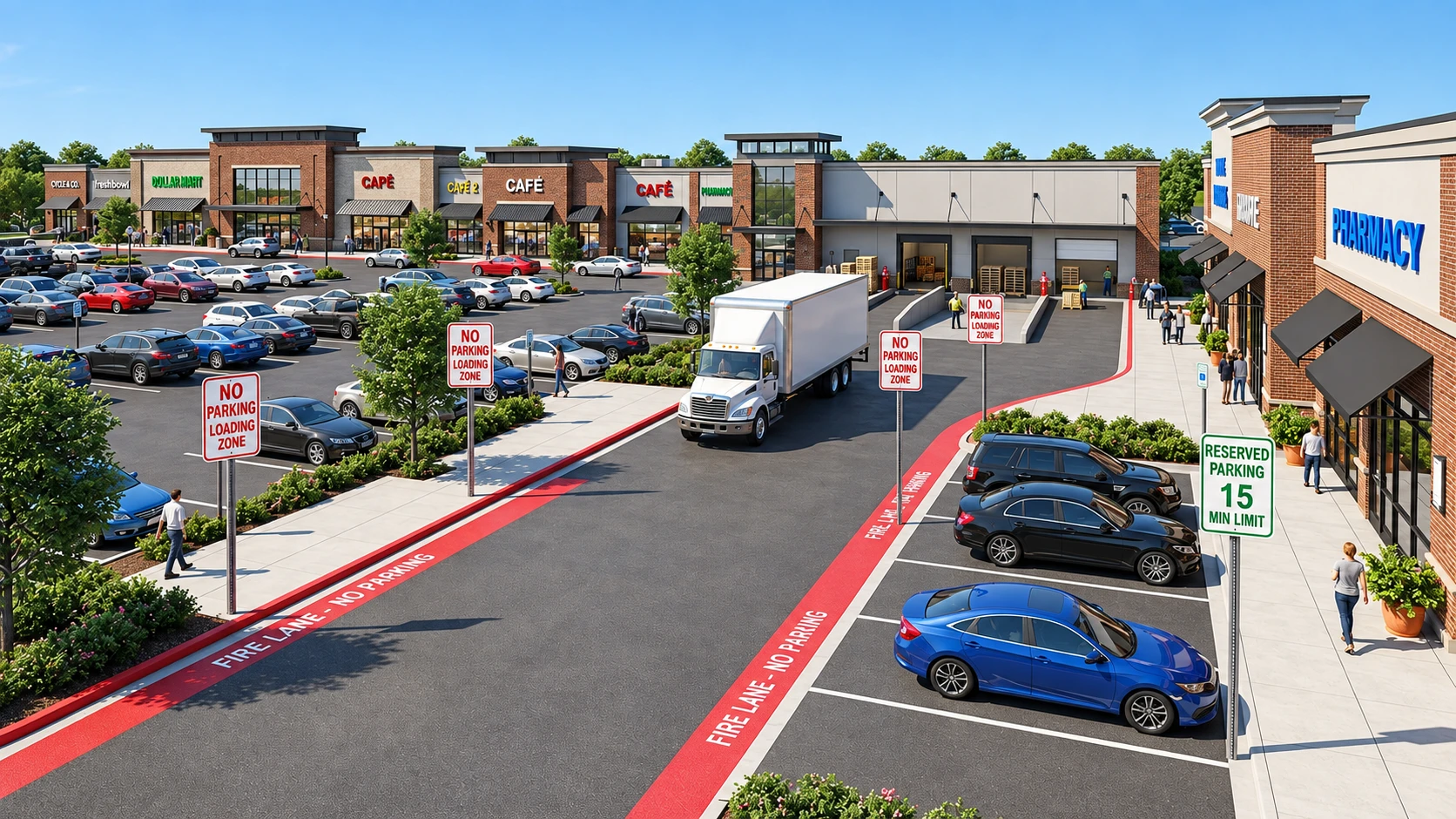
Most parking problems are placement problems. Businesses get blocked deliveries, occupied customer stalls, and vehicles sitting in fire lanes. Then they buy signage. But if a sign goes up where nobody looks, nothing changes.
A no parking sign only works when a driver sees it before they park, not after. That single rule decides almost every placement decision on a commercial lot. Getting it right is part of the same planning that goes into any exterior signage system for a business property.
This guide covers where these signs belong, what materials hold up in Northern BC, and how to make private lot rules actually stick.
Quick Answer: The 7 Spots That Need Parking Signage Most
On a typical commercial property, signage belongs at:
- Fire lanes and emergency access routes
- Loading zones and service doors
- Property entrances and exits
- Driveways and laneway access points
- Reserved, accessible, and staff-only stalls
- Customer-only parking areas
- Property boundary lines where public and private parking meet
Start there. Then walk the lot and look for the spots people actually misuse.
Fire Lanes and Emergency Access Come First
This is the one area with no flexibility. A fire lane no parking sign protects access for emergency vehicles. Blocked lanes create real danger and real liability. These areas usually need signage at both ends of the lane, plus repeat signs along longer runs.
No parking anytime signs suit these zones because the restriction never lifts. There is no “after 6 PM” exception in a fire lane.
Pair the signage with painted curbs or pavement markings where your property allows it. Drivers process two signals faster than one.
Loading Zones and Service Doors
Delivery areas need clear limits too. A no parking traffic sign near a loading door tells regular drivers to keep moving without blocking your suppliers.
Where a restriction covers a stretch of curb rather than one stall, no parking between signs markers work well. One sign marks the start, one marks the end, and the rule applies to everything in between.
Entrances, Driveways and Traffic Flow
Entrances decide how the rest of the lot behaves.
Place signage where a driver reads it while slowing down, not after they have committed to a turn. Roughly three to five metres before the decision point works for most lots.
No parking signs for driveways stop vehicles from blocking access to shared laneways, dumpster pads, and rear service routes. Residential-adjacent properties deal with this constantly, and the fix is usually a single well-placed sign rather than four badly placed ones.
Keep the wording short. A driver moving at 20 km/h reads about four words.
Good traffic flow depends on the same thinking behind directional and wayfinding sign placement inside a property. Every sign should answer one question at the moment it comes up.
Reserved, Private and Customer-Only Spaces
Not every parking sign says “no.”
Reserved parking signs assign specific stalls to staff, management, tenants, or visitors. Mount these at the head of the stall, about 1.5 to 2 metres above grade, facing the approaching driver.
A parking spot sign works best when it names who the space belongs to. “Reserved Unit 4” beats “Reserved” every time. Fewer disputes, fewer phone calls.
Private parking signs mark areas that are not open to the public at all. Retail plazas, medical offices, and shared commercial buildings all use them to separate customer stalls from overflow traffic.
Unauthorized parking signs handle the grey zone: the lot that looks public but is not. These need to be visible from the street entrance, because that is where the driver decides.
Property managers often combine these with permanent property identification like a monument sign at the property entrance so the boundary reads as intentional rather than improvised.
Making Private Property Signage Enforceable
Here is where businesses get caught out. A private property no parking sign is not automatically enforceable. Towing rights on private land depend on municipal bylaws, property ownership, and whether your signage meets local requirements for wording, size, and placement.
A no parking tow-away sign generally needs to state:
- That the property is private
- What the restriction is
- That vehicles may be towed.
- Who to contact, or which towing company is authorized
Some municipalities require a no parking tow-away zone sign at every entrance before any towing is valid. Others have different rules again.
Confirm your local bylaw before you order. Fort St. John, Dawson Creek, and Fort Nelson do not all handle this identically. A quick call to the municipal office saves you from a sign that cannot be enforced.
No parking signs for private property applications also need consistency. If one entrance is signed and another is not, the unsigned entrance weakens your whole position. The same goes for no parking signs for private property across multi-building sites; every access point gets the same treatment.
SignWorks works with property managers on exactly this kind of lot-wide review, because a single missing sign at a back entrance can undo the rest.
Custom No Parking Sign Options for Commercial Properties
Stock signs cover the basics. They cannot cover your property. A custom no parking sign lets you add the information that actually stops problems: your business name, unit numbers, tenant names, towing contact, enforcement hours, or bilingual wording where your customer base needs it.
Commercial parking signs work harder when they match the rest of your property branding. Same colours, same typeface, same finish as your storefront signs and building signage. It reads as a managed property rather than a collection of hardware-store purchases.
Here is what customization solves in practice:
Specific stall assignment. Tenant names and unit numbers cut disputes in multi-tenant buildings.
Local enforcement details. Your towing company, your contact number, your bylaw reference.
Property-matched design. Business parking signs in Fort St. John that look like part of the building, not an afterthought.
Right-sized formats. Larger panels for entrances, smaller for individual stalls.
Directional combinations. One post can carry a restriction and an arrow, cutting your total sign count.
Businesses ordering commercial parking signs in Fort St. John usually find the custom route costs slightly more per unit and far less over five years, because the signs do not need replacing every time a tenant changes. SignWorks produces these in-house, so reprints and additions match the originals instead of being close enough.
Retail properties often fold parking signage into a broader plan alongside signage built for customer-facing retail spaces.
Materials and Posts That Survive Northern BC Winters
Our conditions are hard on cheap signage. A metal no parking sign, usually aluminum or aluminum composite, is the standard for outdoor use. Aluminum will not rust, holds its shape through freeze-thaw cycles, and handles wind loading on exposed lots.
Reflective vinyl faces matter more here than most places. Winter daylight is short. A sign that only reads in daylight is doing half a job.
Parking sign posts deserve equal attention. Galvanized steel U-channel or square tube posts set below the frost line will stay put. Posts set too shallow lift over a few seasons and end up leaning.
For parking lot signs and posts, check three things:
- Post depth: below frost line, always
- Gauge: heavier posts resist snow-clearing impact
- Base type: surface-mount plates work on concrete; direct-bury suits gravel and soil.
Snow clearing causes more sign damage than weather does. Talk to whoever plows your lot before you finalize positions.
Visibility after dark is worth planning too. Many properties pair signage with parking lot and exterior building lighting so the whole area reads clearly at 4 PM in December.
Durable no parking signs in Northern BC come down to material choice, mounting depth, and reflectivity. Get those three right and the signs outlast the lease.
Mounting Height, Spacing and Placement Basics
A parking lot sign works or fails on three measurements. Height. Bottom edge roughly 1.5 to 2.1 metres above grade for driver-facing signs. Higher in areas with heavy snow accumulation, a sign buried in February helps nobody.
Viewing angle. Face the sign toward approaching traffic, not parallel to it. A sign at 90 degrees to the driver is nearly invisible at speed.
Spacing. For long runs, repeat signage every 30 to 60 metres depending on lot size and sightlines.
Parking signs for parking lot use should also survive being looked at from a moving vehicle. Test it yourself. Drive your own lot and see what you can actually read.
Installation quality decides how long any of this lasts, which is why proper sign installation affects far more than appearance. Poorly anchored posts are the most common failure we see.
Some property owners handle small signs themselves. For anything requiring post setting or concrete work, the maths usually favours professional installation, a point covered in detail in the real cost of do-it-yourself sign installs.
Permits, Costs and Timelines
Most parking signage on private property does not require a permit. Most. Exceptions come up with illuminated signage, signs near public right-of-way, larger structures, and properties under specific zoning or development permit conditions. Landlord approval is also common on leased sites. Check before fabrication, not after.
Cost depends on quantity, material, size, post requirements, and whether installation involves concrete work. A single stall sign and a full lot signage package are different projects.
Timelines follow a predictable pattern: design approval, fabrication, then installation scheduling. Winter installs take longer where ground conditions affect post setting. Plan lot signage in spring or fall when possible.
Budgeting questions come up constantly, and choosing a sign company without overpaying is worth reading before you collect quotes.
Keeping Parking Signage Working Long-Term
Signs fade. Posts loosen. Tenants change. Walk your lot once a year and check for faded faces, bent posts, outdated tenant names, and signs hidden by grown landscaping. That last one catches people out more than you would expect.
Our guide to keeping business signage in good condition covers the wider maintenance routine.
Temporary situations construction, events, seasonal closures often need short-term signage rather than permanent posts. Banners, portable signs and temporary site markers handle those without committing to hardware you will remove in six weeks.
Planning Your Lot Signage
Start with a walkthrough. Photograph every entrance, fire lane, loading door, reserved stall, and problem area. Note what is signed, what is faded, and what gets ignored.
That list is your scope.
SignWorks has designed, fabricated, and installed signage for commercial properties across Fort St. John, Charlie Lake, Dawson Creek, and the wider Peace Region since 1992. Everything is made locally, which matters when you need three more signs that match the twelve you already have.
Property owners looking at no parking signs in Fort St. John can bring their walkthrough photos and lot dimensions to a consultation. It is the fastest route to a quote that fits the property.
If you want a second opinion on your lot layout before ordering, get in touch with the SignWorks team. Thirty years of local sites gives you a reasonable head start on what will work.
Frequently Asked Questions
Q: Where should no parking signs be placed on a commercial property?
A: Place them at fire lanes, loading zones, property entrances and exits, driveways, reserved stalls, customer-only areas, and boundary lines between public and private parking. Signs should be visible before a driver commits to parking, not after.
Q: How high should a parking sign be mounted?
A: The bottom edge should typically sit 1.5 to 2.1 metres above grade for driver-facing signs. In areas with heavy snow, mount higher so signage stays visible through winter.
Q: Can I tow a vehicle from my private parking lot?
A: It depends on local bylaws. Most municipalities require clear signage at entrances stating that the property is private, that parking is restricted, and that vehicles may be towed. Confirm your specific municipal requirements before relying on signage for enforcement.
Q: What material is best for outdoor parking signs in Northern BC?
A: Aluminum or aluminum composite panels with reflective vinyl faces. Aluminum resists rust and handles freeze-thaw cycles. Reflective faces keep signs readable during short winter daylight hours.
Q: How deep should parking sign posts be set?
A: Below the local frost line. Posts set too shallow shift and lean after a few freeze-thaw seasons. Galvanized steel U-channel or square tube posts are the usual choice.
Q: Do I need a permit for parking signs on private property?
A: Usually not for standard non-illuminated signage on private land. Permits may apply for illuminated signs, signs near public right-of-way, larger structures, or properties with specific zoning conditions. Landlord approval is often required on leased sites.
Q: Are custom parking signs worth it over stock signs?
A: Custom signs let you include tenant names, unit numbers, towing contacts, and enforcement hours details that prevent disputes. They also match your property branding. Over several years, they often cost less because they do not need replacing when circumstances change.
Q: How many signs does a parking lot need?
A: It depends on lot size and layout. As a starting point, sign every entrance, both ends of any fire lane, each reserved stall, and repeat signage every 30 to 60 metres along long runs.
