
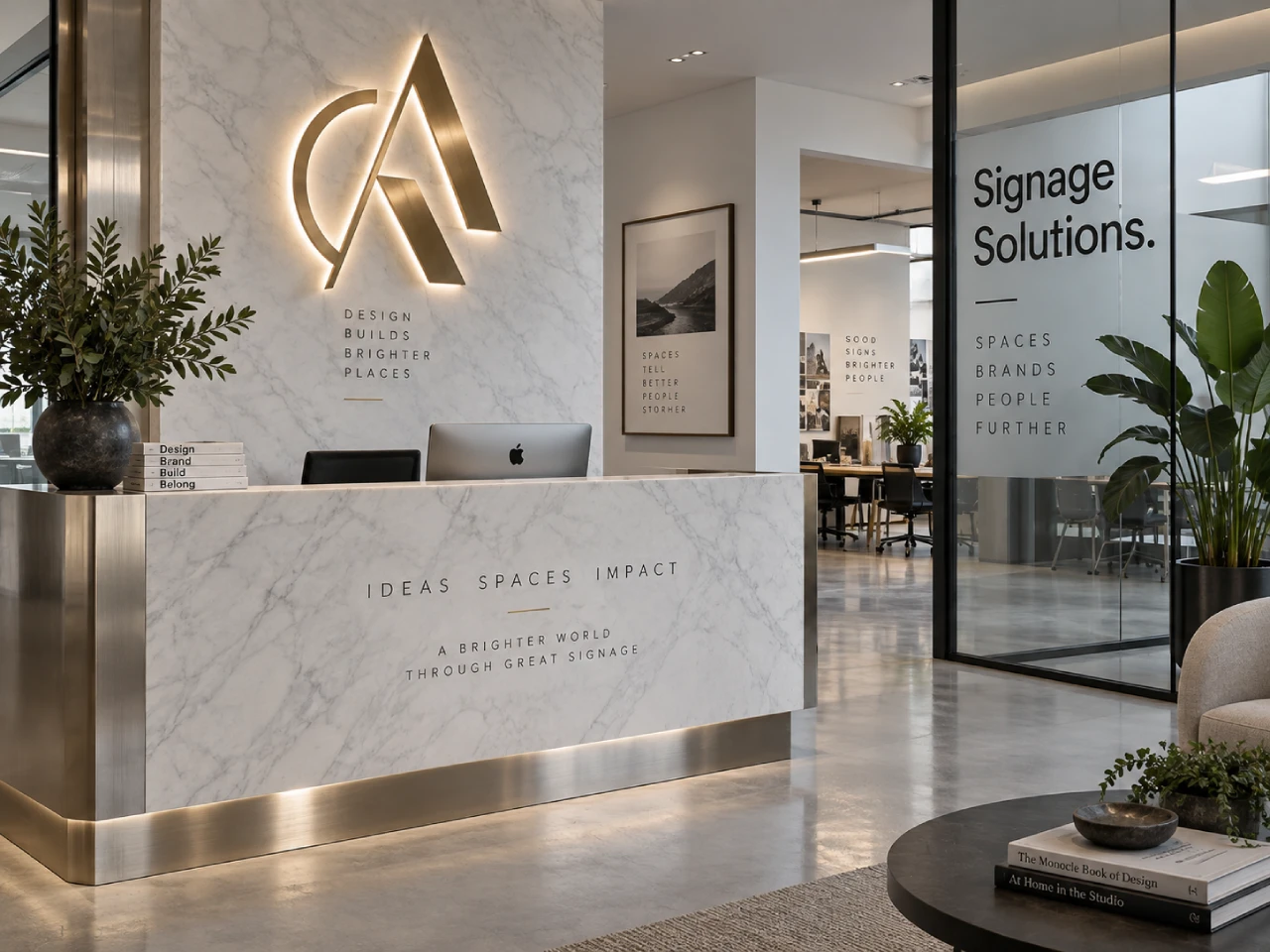
Most interior sign projects land somewhere between $150 and $7,000 per sign. That is a wide gap, and there is a good reason for it. A vinyl window decal and a lit reception logo are not the same job. Size, material, lighting, and install access all move the number. If you want a straight answer for your own space, the fastest route is a quick site review with a local sign shop in Fort St. John. This guide breaks down what you actually pay for when you order indoor signage, so you can budget with confidence instead of guessing.
Quick Answer: Typical Interior Sign Price Ranges
Here are ballpark figures we see across the industry. Treat them as a starting point, not a quote.
| Sign type | Typical installed range |
| Vinyl wall lettering or window decal | $150 – $600 |
| Acrylic or PVC lobby sign with dimensional lettering | $600 – $2,500 |
| Lobby directory signs (changeable inserts) | $500 – $3,000 |
| Wall graphics and full-wall murals | $12 – $25 per sq. ft. |
| Wayfinding signs (package of 10–20 units) | $2,000 – $10,000 |
| Illuminated logo or halo-lit sign | $1,500 – $7,000+ |
| Portable event signs, retractable banners | $200 – $900 |
Notice the spread inside each row. That spread is where the seven factors below live.
7 Factors That Change Your Indoor Signage Price
1. Size, Scale, and How Many You Need
Higher costs more, but not in a straight line. Doubling the height of a letter can more than double the material used. It may also push you into a thicker substrate so the piece stays flat and rigid.
Quantity works the other way. One custom directional sign is expensive per unit. Twenty matching signs from the same template drop the per-sign price a lot. Setup, artwork prep, and machine time get spread across the batch. If you know you will need more signs inside the building next year, order them now.
2. Material Choice Sets the Floor
Material is the single biggest lever on cost. From least to most expensive, most interior signs use:
- Vinyl: decals, cut lettering, printed wall graphics. Cheapest, fastest, great for promotions.
- PVC and foam board: light, paintable, good for budget dimensional lettering.
- Acrylic: clean edges, stand-off mounted, the classic reception look.
- Brushed or painted aluminum: durable, premium feel, common in offices and clinics.
- Wood, metal composites, and layered builds: highest cost, highest impact.
A quick tip from the shop floor: acrylic with a brushed aluminum face reads as premium at a fraction of solid metal pricing. Ask your fabricator about face-mounted overlays before you approve a solid metal build.
3. Lighting Adds Cost and Adds Punch
Add LED and your price jumps. You are no longer buying a sign. You are buying a sign plus a power supply, plus wiring, plus an electrician’s time.
Halo-lit lettering, edge-lit acrylic panels, and backlit cabinets all run higher than unlit pieces. They are still worth it in reception areas, restaurants, and retail, where a glow pulls the eye from across the room. Our lit sign options cover both interior and exterior work, and we will tell you honestly when a space does not need light at all.
One detail people miss: designers who work on sign interiors know the guts of a lit cabinet control how even the glow looks. Cheap builds show hot spots and dark corners. That is a fabrication issue, not a design issue.
4. Design Complexity and Artwork Prep
If you hand over clean vector files, you save money. If your logo only exists as a low-res JPEG from 2011, someone has to rebuild it. That is real design time.
Complexity matters too. Two-colour flat lettering is simple. Layered pieces with drop shadows, custom shapes, and mixed materials take longer to cut, paint, and assemble. Gradients and photo-realistic wall art need printed vinyl rather than cut vinyl, which changes the process entirely.
Good design is not just a style choice. A sign with poor contrast or a hard-to-read typeface fails at its job. We cover more layout thinking in creative ways to draw in more customers.
5. Installation Access and Site Conditions
Two identical signs can cost very different amounts to install. What changes it:
- Wall type: Drywall is easy. Concrete, brick, and glass need anchors, adhesives, or specialty hardware.
- Height: Anything above reach means lifts or scaffolding.
- Building rules: After-hours work in an occupied office or mall costs more than a weekday install.
- Power. A lit sign with no nearby circuit means an electrician joins the project.
Our crews at SignWorks handle mounting, levelling, and clean-up as part of the job, and we survey the site before quoting so nobody gets a surprise line item. That same field experience shows up in our safety and site signage for industrial spaces, where install conditions are rarely simple.
6. Permits, Codes, and Landlord Approvals
Good news first. Most interior signs do not need a municipal sign permit. Exterior work usually does.
But there are exceptions worth checking:
- Anything visible through a window may count as exterior signage in some bylaws.
- Electrical work on illuminated pieces can trigger an inspection.
- Exit, accessibility, and fire route signs must meet building code and braille or tactile standards.
- Leased space almost always means landlord sign-off on wall attachments and finishes.
Send your lease’s signage clause to your sign company early. It takes five minutes and saves rework.
7. Lifespan, Warranty, and Maintenance
The cheapest quote is rarely the cheapest sign. Thin vinyl on a high-traffic corridor peels in a year. Budget LEDs fade unevenly. A properly built acrylic piece stays sharp for a decade.
Ask three questions before you sign: What is the warranty on materials? What is the warranty on labour? Who fixes it if an LED strip fails in month fourteen? A fabricator who builds in-house can answer all three. A reseller usually cannot.
Why Custom Business Signs Do More Than Look Good
Custom business signs are working assets, not decoration. They do five jobs at once. They confirm people are in the right place. A visitor walks in and looks for your name. A clean reception piece answers that in under a second and sets the tone for the whole meeting.
They guide people without staff involvement. Custom wayfinding signs cut down on “where do I go?” questions. In clinics, shops, warehouses, and multi-tenant buildings, a wayfinding sign at every decision point keeps traffic moving. Wayfinder signs work best when they use consistent colours, arrows, and terminology floor to floor. Lobby directory signs with changeable inserts are the smart pick for buildings where tenants rotate.
They reinforce your brand every day. A signage wall behind the front desk puts your logo in every photo, every video call, and every customer memory. That kind of sign wall costs once and markets forever.
They support short-term pushes. Event signs, seasonal window decals, and removable floor graphics let you promote without touching the permanent build. Our decals and banners cover exactly this kind of flexible messaging.
They build trust. Cheap, faded, or crooked signs inside a space quietly tell customers you cut corners. Sharp interior signage tells them the opposite. Cool signage also gets photographed and shared, which is free reach you did not pay for.
A Real-World Example from the Peace Region
A local clinic came to us needing more than a front sign. They had patients wandering hallways and staff giving directions all day.
The build: one acrylic reception logo with stand-offs, eleven matching hallway directional panels, two frosted privacy window films, and a printed wall graphic in the waiting room. The wayfinding signs used a shared template, which kept the per-unit price low. The reception piece took the bigger share of the budget because that is the one every patient sees first.
Total install was under two days. Staff interruptions dropped almost immediately. That is the practical return on indoor business signs: fewer questions, smoother flow, better first impressions.
Deciding where to put your dollars first? Our breakdown of how indoor and outdoor signs compare helps you sequence the spend.
How to Budget Without Cutting Corners
A few habits keep projects on track:
- Phase it: Reception and wayfinding first. Decorative graphics later.
- Standardize: One template across all interior signs lowers cost and looks more professional.
- Bundle the install: One trip beats three. Combine interior work with window graphics or exterior updates.
- Compare apples to apples: When you weigh quotes from regional shops or larger outfits like Allen Signs, check whether design, permits, hardware, and install are included or listed separately.
- Think in years: Divide the cost over the sign’s expected life. A $2,000 lobby sign that lasts ten years costs $200 a year.
Money spent well on signage is one of the few marketing costs that never stops working. It does not expire like an ad buy.
How SignWorks Plans, Builds, and Installs
SignWorks has been locally owned since 1992, serving Fort St. John and businesses across the Peace Region. Our process is straightforward.
We start with a site walk-through and your brand files. Then we mock up the design in place, so you see the piece on your actual wall before we cut anything. Fabrication happens in our own shop, which keeps quality and timelines under our control. Installation is handled by our crews, including hard-access work most shops pass on.
That range of capability from commercial signage solutions to vehicle wraps and fleet graphics means one company can cover your whole visual identity. You can browse the full list of what we build or meet the team behind every build.
Typical timeline: 1–2 weeks for simple vinyl and printed work, 3–5 weeks for dimensional or illuminated builds. Rush work is often possible. Ask.
Ready for a real number instead of a range? Talk to us about your project, and we will walk your space, take measurements, and send a clear itemized quote. For more planning guidance, including safety signs that cut down workplace accidents, visit our signage blog.
FAQ’s
Q: How much do custom indoor signs cost?
A: Most interior signs run between $150 and $7,000 installed. Vinyl wall lettering and window decals sit at the low end. Dimensional acrylic lobby signs typically range from $600 to $2,500. Illuminated interior signs start around $1,500 and climb based on size and lighting method. Custom indoor signs cost more when they use premium materials, LED lighting, or difficult mounting surfaces.
Q: What affects custom sign pricing the most?
A: Material and lighting. Vinyl is the cheapest option, while acrylic and aluminum cost more. Adding LED lighting raises the price because it requires a power supply, wiring, and often an electrician. Size, design complexity, and installation access come next.
Q: Do I need a permit for signs inside my building?
A: Usually no. Municipal sign permits generally apply to exterior signage. However, illuminated interior signs may require an electrical inspection, and exit or accessibility signs must meet building code. If you lease your space, your landlord will likely need to approve any wall-mounted installation.
Q: How long does it take to get interior signs made and installed?
A: Simple printed or vinyl work typically takes one to two weeks. Dimensional lettering and illuminated builds usually take three to five weeks from approved artwork to install day. Site conditions and permit or landlord approvals can extend the timeline.
Q: How many wayfinding signs does a building need?
A: Place a sign at every decision point, entrances, elevator lobbies, hallway junctions, and stairwells. Most small commercial buildings need 10 to 20 units. Using one consistent template across the set keeps per-sign cost low and makes the system easier to follow.
Q: What is the best material for interior business signs?
A: Acrylic is the most popular choice for reception and lobby signs because it delivers clean edges and a premium look at a moderate price. Aluminum suits high-durability areas. Vinyl is best for temporary promotions, window graphics, and murals.
Q: How long do indoor signs last?
A: Quality acrylic and aluminum signs last 10 years or more indoors. Vinyl wall graphics typically last 3 to 7 years depending on traffic and surface. LED components usually carry a 3 to 5 year warranty. Ask for both material and labour warranty terms before ordering.
Q: Does SignWorks serve businesses outside Fort St. John?
A: Yes. Creative SignWorks Inc. serves Fort St. John and communities across the Peace Region, including surrounding industrial, retail, healthcare, and multi-tenant commercial sites.
