
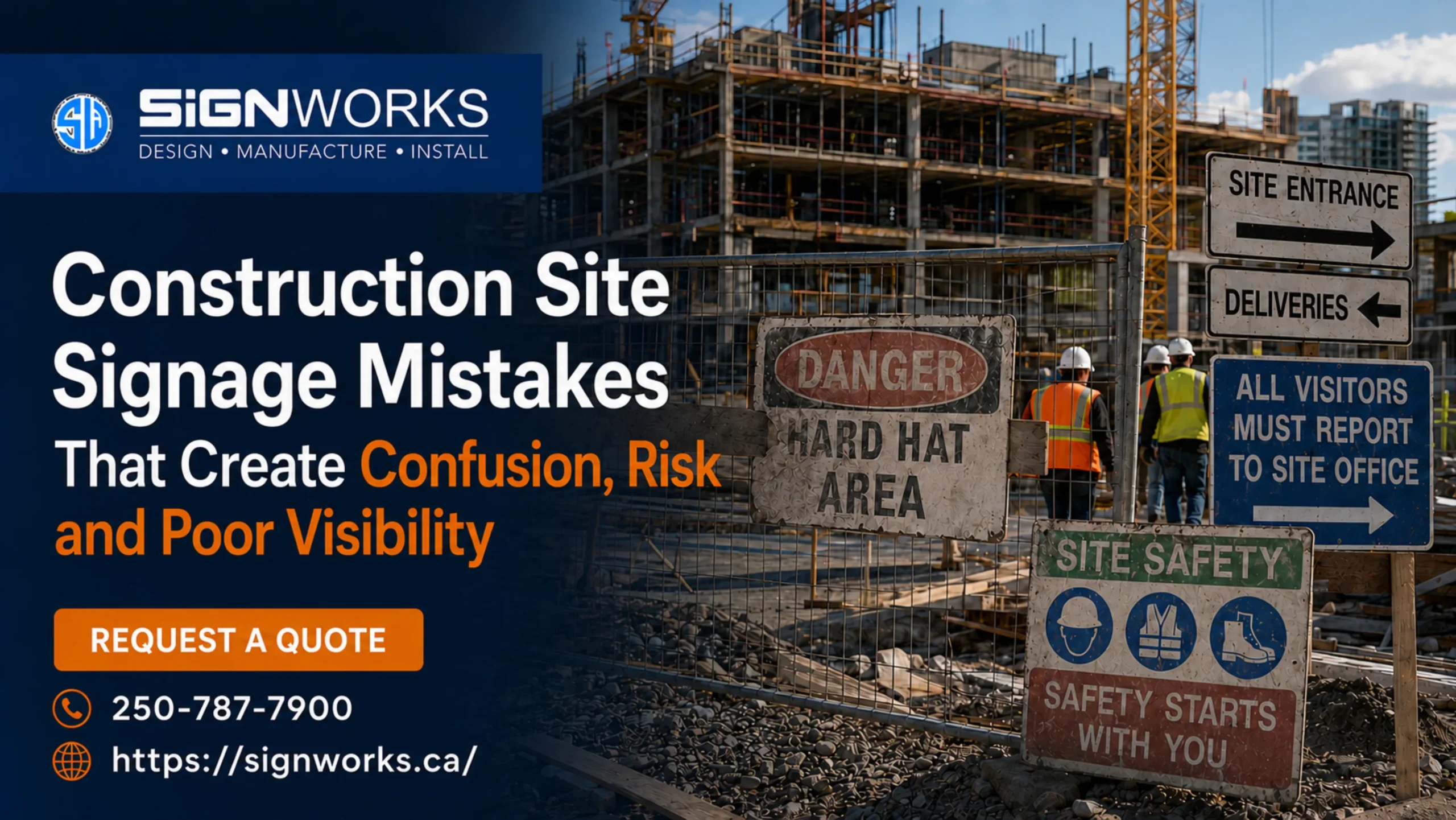
Construction Site Signage Mistakes That Create Confusion, Risk, and Poor Visibility
Construction site signage should help people understand a jobsite before they enter an active work area. It should identify the correct entrance, explain access rules, direct vehicle traffic, mark pedestrian routes, and warn people about hazards at the right time. Problems arise when signs are treated as minor finishing details. A poorly positioned warning, an unclear delivery instruction or a faded PPE notice can create uncertainty for workers, subcontractors, visitors, and drivers.
These issues become more serious on busy industrial and building projects. Equipment may move through narrow areas, temporary fencing may change, and several contractors may perform different activities at once. Construction site safety signage must keep pace with those conditions.
Projects in Fort St. John also face Northern BC weather. Snow, freezing temperatures, wind, moisture and limited winter daylight can reduce visibility or damage signs made from unsuitable materials.
SignWorks produces oilfield and construction safety signage for clients in Fort St. John and the surrounding Peace Region. Avoiding the following mistakes can make construction site signs clearer, more durable and easier to use.
Mistake 1: Ordering Signs Without Reviewing the Site Layout
A construction company may order common safety signs before confirming where entrances, parking areas, storage zones and equipment routes will be located.
This can result in a collection of signs that does not match the actual site. The team may have enough “Caution” panels but no clear directions for deliveries, pedestrian traffic or visitor check-in.
Construction site signage should begin with a review of how people and equipment move around the property. The review should include normal operations, shift changes, deliveries and emergency conditions.
Map Important Decision Points
A decision point is any location where a person needs information before choosing what to do next. Examples include the public road approaching the site, the main gate, a pedestrian crossing and the entrance to a controlled work area.
Each decision point should have the correct instruction before the person reaches it. A restricted area safety sign warning installed several metres inside the controlled area is too late. Mapping these locations helps the project team determine which signs are necessary and which messages can be removed.
Connect Signage to Jobsite Organization
Effective jobsite organization depends on predictable routes and clear boundaries. Workers should know where to park, where to walk, and where equipment has priority.
Signs support this structure by making the site plan visible. When the layout changes, the signage should change with it. Old instructions should not remain in place after a route or work zone has moved.
Mistake 2: Creating a Confusing Construction Site Entrance
The entrance sets expectations for everyone arriving at the project. If it is poorly marked, people may enter through the wrong gate, park in an equipment route, or walk into an active area without checking in.
Construction site entrance signs should be visible before a driver turns into the property. The message may identify the project, visitor procedure, required PPE, and appropriate delivery access.
The exact information depends on the site. A small commercial renovation may need one clear entrance panel, while a large industrial project may require separate signs for workers, visitors and heavy deliveries.
Make Construction Site Entrance Signs Easy to Read
Construction site entrance signs must be large enough for the expected viewing distance. Drivers should not need to stop suddenly or reverse because they could not read the directions in time.
Use concise wording and clear arrows. Detailed policies can be displayed at the check-in location, while the roadside sign should focus on immediate directions.
The entrance should also remain visible after dark and during winter. Snowbanks, parked trucks, and open gates should not block the main sign.
Clarify Delivery Access
Delivery access should be identified before a truck reaches the general entrance. Large vehicles may require a wider gate, different route, or designated waiting area.
A clear sign can identify the receiving entrance, radio channel, phone number, or check-in instruction approved by the project team.
Good delivery signage reduces unnecessary reversing and helps prevent drivers from entering pedestrian or forklift zones.
Mistake 3: Using General Warnings Instead of Clear Instructions
Generic construction hazard signs are widely available, but they may not communicate enough information for a specific jobsite.
A sign that only says “Warning” does not tell people what the hazard is or what action they should take. A symbol without explanatory text may also be unclear to visitors who are unfamiliar with the site.
Custom hazard signs allow the project team to communicate an approved instruction in plain language.
State the Hazard and Required Action
A practical message might say “High Voltage Warning: Authorized Electricians Only” or “Forklift Traffic: Use Marked Pedestrian Route.”
These messages explain both the condition and the expected response. The wording should be brief enough to read quickly but specific enough to prevent uncertainty.
If the procedure requires extensive details, use the main sign to communicate the immediate action and direct people to a separate information board.
Avoid Complicated Technical Language
Building construction site signage may be viewed by workers, visitors, inspectors, delivery drivers, and members of the public. Not everyone will understand specialized terminology.
Use familiar language wherever possible. Safety personnel should review the message to confirm that it accurately represents the hazard without becoming difficult to understand.
Mistake 4: Failing to Define Restricted Access Areas
A controlled work zone needs a clear boundary. One restricted access sign placed on a long fence may not make it obvious which gate or area is affected.
Restricted area signs should appear at every normal entry point. They should tell people who may enter and whether additional conditions apply.
The wording could include “Authorized Personnel Only,” “Permit Required Before Entry,” or “Visitors Must Report to the Site Office.” The project safety team should approve the language.
Place Restricted Area Signs Before the Boundary
A person should see the warning while there is still time to stop. Installing it after the entrance weakens its purpose.
Construction site access signage can combine the restriction with a direction. For example, a panel could state that public access is prohibited and direct visitors to another gate.
This approach helps prevent unauthorized entry while giving legitimate visitors a clear next step.
Use Consistent Restricted Access Wording
Several different phrases for the same restriction can create doubt. If one gate says “No Entry,” another says “Staff Only” and a third says “Controlled Zone,” people may assume that each message has a different meaning.
Choose approved terminology and use it consistently. A coordinated set of restricted area signs makes the site easier to understand and inspect.
Mistake 5: Mixing Pedestrians With Equipment Traffic
Workers and equipment often share limited space on construction projects. When routes are not marked clearly, pedestrians may take shortcuts through vehicle operating areas.
Construction site safety signs should support the approved traffic flow. They can identify equipment routes, pedestrian paths, crossings, speed limits, and areas where mobile machinery has priority.
Signs do not replace physical separation where it is required, but they reinforce the intended movement plan.
Mark the Pedestrian Route From the Entrance
A pedestrian route should be easy to follow from the parking area to the office, welfare facilities and work zones.
Directional signs may be needed where the route turns, crosses a road, or passes behind temporary structures. One sign at the start may not be enough on a large project.
The route should be inspected whenever fencing, materials, or equipment positions change. A sign pointing toward a blocked path creates more confusion than having no sign at all.
Install Forklift Traffic Signs at the Right Location
Forklift traffic signs should warn pedestrians before they enter an operating area. They can also remind equipment operators to watch for crossings.
Custom forklift traffic signs may include an approved speed limit, stop instruction, or crossing requirement. The message should match the site traffic plan.
The warning should not be placed inside the forklift zone where a pedestrian has already encountered the hazard.
Mistake 6: Overloading Gates and Fences With Too Many Signs
A construction entrance may display safety rules, contractor names, delivery information, emergency notices, and promotional banners. When too many messages appear together, the most important instructions become difficult to identify.
Sign clutter reduces the impact of construction site safety signage. Readers may ignore the entire group because they cannot decide what to read first.
Create a Clear Information Hierarchy
The largest and most visible message should address the immediate decision. At a gate, this may be the entrance instruction or access restriction.
PPE requirements can appear next, followed by check-in details. General project notices should be placed on a separate board where people can stop and read safely.
This hierarchy improves visibility without removing necessary information.
Review Construction Site Fence Signage
Temporary fencing is a convenient location for construction site fence signs, but it can also create installation problems.
Fence panels may shift, turn, or lean in high winds. Large solid signs can increase the wind load on temporary structures. The mounting method and sign dimensions should suit the fence and local conditions.
Fence signs should be inspected regularly to confirm that they remain secure, upright, and facing the intended approach.
Mistake 7: Selecting Materials That Do Not Suit Northern BC Weather
A sign designed for a protected indoor location may not survive outdoors. Moisture can damage temporary notices, while cold temperatures and dirty surfaces can affect unsuitable adhesives.
Northern BC weather can also hide or obstruct signage. Low-mounted panels may disappear behind snowbanks, and dark winter conditions can make low-contrast graphics difficult to see.
Material selection should consider the location, expected lifespan, and importance of the message.
Choose Aluminum Safety Signs for Long-Term Use
Aluminum safety signs are appropriate for many durable exterior applications. Aluminum panels are rigid, lightweight, and resistant to rust.
The correct thickness depends on sign size, wind exposure, and mounting conditions. A larger panel attached to a gate or fence requires secure hardware and careful positioning.
The printed graphics and protective finish must also suit the environment. A durable substrate cannot compensate for graphics that were not produced for exterior exposure.
Use Laminated Signs for Suitable Applications
Laminated signs can provide added surface protection and make printed graphics easier to clean. They may be useful for protected locations or temporary instructions.
Not every laminated notice is suitable for extended outdoor exposure. A sign provider should understand where the panel will be installed and how long it needs to remain in service.
Consider Reflective Vinyl
High-Visibility Vinyl can improve visibility when light reaches the sign during darker conditions. It may be helpful for entrance instructions, traffic directions, speed limits, and emergency locations.
Reflectivity does not replace proper site lighting. The panel must still face the expected approach and remain free from mud, snow and other obstructions.
Mistake 8: Installing PPE Signs After the Hazard Begins
PPE required signs must give people enough time to put on the correct equipment before entering a controlled area.
A hard hat notice mounted inside the work zone communicates the requirement too late. The same problem occurs when eye or hearing protection signs are positioned beside the hazard rather than at the entrance.
Custom PPE signs can clearly state the equipment required at each boundary.
Position Hard Hat Area Signs at Every Entrance
Hard hat area signs should appear at all normal access points to the designated zone. If the boundary changes during construction, the signs should move with it.
Leaving an outdated hard hat area sign in place can weaken confidence in other site instructions. Workers may begin to assume that signs no longer reflect actual conditions.
Identify Eye Protection Requirements
An eye protection required sign may be appropriate at grinding, cutting, fabrication, or chemical handling areas.
The wording should match the project’s safety procedure. If a specific type of protection is required, the safety team should determine whether that detail needs to appear on the sign.
Mark Hearing Protection Zones
A hearing protection required sign can identify the boundary of a designated high-noise area.
The sign should be installed before exposure begins. Project management should determine the location and wording based on its assessments and approved procedures.
Mistake 9: Allowing Signs to Become Hidden or Damaged
Signs can become ineffective even when they were installed correctly at the beginning of a project. Materials, waste bins, vehicles, and equipment may later block them.
Mud can cover low panels, while wind can turn temporary signs away from their intended audience. Printed graphics may fade or become difficult to read.
Regular sign inspections are therefore part of maintaining a clear jobsite.
Check Visibility From the Reader’s Position
Inspect signs from the route used by the intended reader. A panel may look visible from the office but remain hidden from a driver approaching the gate.
For traffic signs, check visibility at the normal approach speed. Drivers need enough time to read the message and respond safely.
For pedestrian signs, confirm that the instruction appears before the route changes or the controlled area begins.
Replace Outdated Signs Promptly
Construction conditions change quickly. A route used during excavation may no longer be appropriate after structural work begins.
Old signs should be removed rather than left beside new instructions. Conflicting arrows and access messages can disrupt site traffic movement and increase the likelihood of an incorrect decision.
Mistake 10: Neglecting Emergency Signage
Emergency resources may receive less attention because they are not used during normal operations. During an incident, however, workers must be able to locate them immediately.
Emergency signs should have a consistent appearance and remain separate from general notices. They should be visible from common work and travel areas.
Clearly Identify the Muster Point
A muster point sign marks the designated gathering location during an evacuation. Its position should reflect the project’s emergency response plan.
Large sites may require directional signs leading to the point. One panel at the destination does not help workers who do not know the route.
The location must remain accessible and visible throughout winter. Snow storage, materials, and parked vehicles should not block the sign or gathering area.
Mark the First Aid Station
A first aid station should be identifiable from nearby work zones. If it is inside a trailer or building, exterior and directional signs may be necessary.
When the aid station moves, all related directional signs should be updated. Temporary facilities often change location as construction progresses.
Mistake 11: Ignoring Branding and Professional Presentation
Safety is the first purpose of construction site signage, but a coordinated design also reflects the organization managing the project.
Mismatched fonts, poor-quality printing and damaged panels can make the jobsite appear disorganized. Clear custom construction signage creates a more professional experience for clients, inspectors, subcontractors and visitors.
Brand colours can sometimes be used for project identification and directional signs. However, recognized safety colours and approved hazard formats should not be altered simply to match a logo.
For project branding and permanent facility signs, SignWorks also offers commercial signage in Fort St. John.
How to Plan Better Custom Safety Signage
A practical sign plan begins with a site walk. Record each entrance, route, crossing, restricted area, PPE boundary and emergency resource.
For every proposed sign, document the approved wording, dimensions, quantity, installation surface, viewing distance and expected exposure. Site photographs can help the sign provider understand mounting conditions and possible obstructions.
Group the signs by purpose, such as access, traffic, PPE, hazard, emergency and directional information. This makes it easier to maintain consistent terminology and design.
SignWorks can assist with construction sign printing after the client approves the messages and specifications. Clients can explore the company’s professional signage services for additional information.
Why Work With SignWorks in Fort St. John?
SignWorks is a locally operated sign company serving Fort St. John and other Northern BC communities. Its team understands that signs used on industrial and construction properties must be clear, durable, and appropriate for demanding conditions.
Clients can learn more about the SignWorks staff and view the company’s Google Business Profile and customer reviews.
Whether a project needs construction site entrance signs, custom hazard signs, forklift traffic signs, or a coordinated custom safety signage package, SignWorks can help produce the approved designs in suitable materials.
Request Construction Site Signage in Fort St. John
Good construction site signage helps workers, visitors and drivers understand where to go, what to avoid and which rules apply.
The strongest sign systems are planned around real site conditions. They use clear wording, durable materials and carefully selected locations rather than relying on a random collection of generic panels.
Visit SignWorks to explore its local signage capabilities or contact SignWorks for a construction signage quote. Provide the sign wording, quantities, dimensions, site photographs and required completion date to help the team evaluate your project.
Frequently Asked Questions
What Is Construction Site Safety Signage?
Construction site safety signage communicates hazards, access rules, PPE requirements, emergency locations and traffic directions. It supports the site safety plan by placing important instructions where workers, visitors and drivers need them.
What Should Construction Site Entrance Signage Include?
A construction site entrance sign may include the project name, visitor check-in procedure, access restrictions, basic PPE requirements, and delivery directions. The content should reflect the actual entrance and traffic plans.
Where Should Restricted Area Signs Be Installed?
Restricted area signs should be installed at every normal entry point to the controlled zone. The reader should see the warning before crossing the boundary.
Are Aluminum Safety Signs Suitable for Outdoor Jobsites?
Aluminum safety signs are suitable for many exterior applications because they are rigid, lightweight,t and resistant to rust. Their thickness, finish and mounting hardware should suit the panel size and local exposure.
When Should Reflective Vinyl Be Used?
High-Visibility Vinyl may improve visibility for entrance, traffic and emergency signs viewed during darker conditions. Its effectiveness depends on the available light, viewing angle and placement.
Can SignWorks Produce Custom PPE Signs?
Yes. SignWorks can produce client-approved custom PPE signs, including hard hat area signs, eye protection required notices and hearing protection required signs.
How Often Should Construction Site Signs Be Inspected?
Signs should be reviewed during regular site inspections and whenever entrances, hazards, traffic routes, fencing, or emergency procedures change. Damaged, hidden, and outdated signs should be corrected promptly.
What Information Is Needed for Construction Sign Printing?
Provide the approved wording, dimensions, quantities, installation locations, and environmental exposure. Photos, mounting information, and the required completion date can help SignWorks prepare an accurate quote.
